
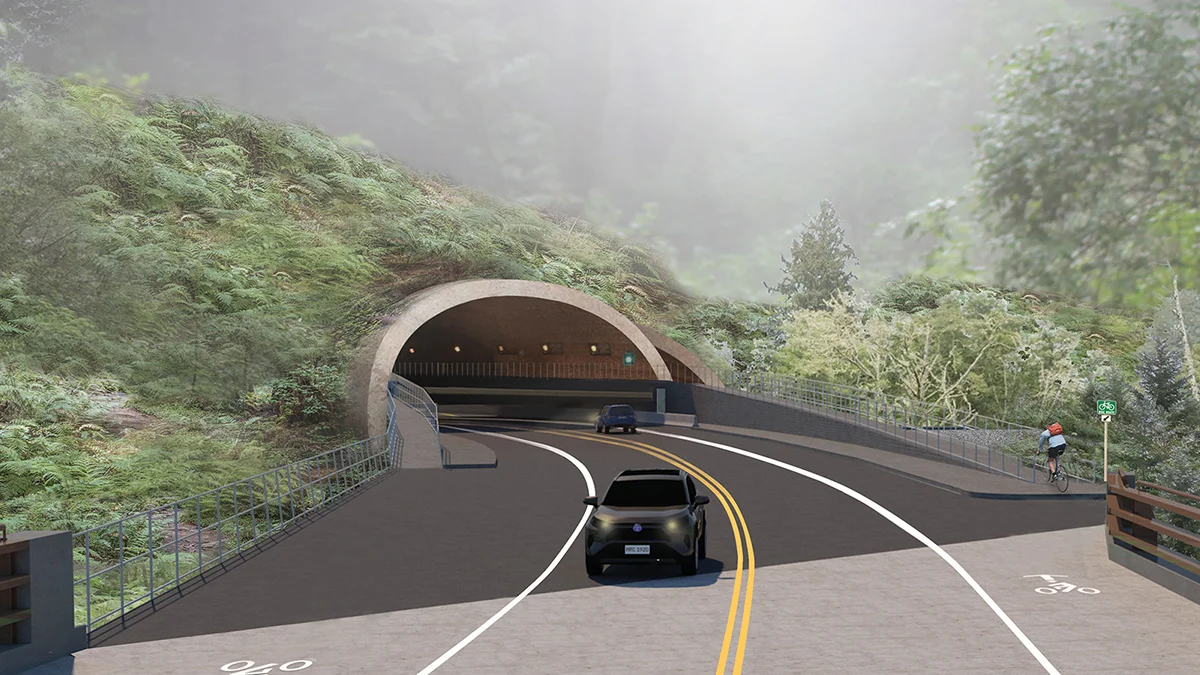
The tunnel will carry US Highway 101 beneath an unstable section of the coastal route in Del Norte County that has been affected by repeated landslides and emergency closures for decades.
Caltrans’ selected alternative involves construction of an approximately 1.83km tunnel east of the existing highway, bypassing the most landslide-prone section of Last Chance Grade. The bore would become the longest highway tunnel built by Caltrans.
Current California Transportation Commission (CTC) documents put the estimated construction cost at US$2.5bn–US$3.5bn, although construction funding has yet to be secured. Around US$225M has been identified for design and right-of-way support, with Caltrans expected to pursue a combination of state, federal and financing sources for the main works.
The project has now completed the Project Approval and Environmental Document (PA&ED) phase, which included environmental and engineering studies, consultation with agencies and communities and selection and approval of the preferred alignment.
Design work will now be developed for the tunnel and portals, connecting highways, bridge works, drainage, safety systems and operations and maintenance facilities. Further geotechnical investigations, permitting, mitigation work and cost refinement will also be undertaken.
Caltrans said it anticipates using advanced underground construction technologies to improve safety and excavation precision while minimising surface disturbance. Technologies being considered include precision excavation equipment, robotic shotcrete application and real-time monitoring.
The delivery strategy will also include specialist tunnel designers, early Construction Manager/General Contractor (CM/GC) involvement, independent cost estimating, additional geotechnical investigations and phased design reviews intended to manage risk and refine the construction cost.
Last Chance Grade forms part of US 101, a critical north-south transport corridor along California’s North Coast. The section has suffered chronic ground movement, requiring repeated repairs, traffic restrictions and emergency closures.
A major failure resulting in a prolonged closure could force traffic onto an alternative route through Oregon and inland northern California, adding around eight hours to journeys. Caltrans said such a closure would have significant consequences for residents, emergency services, freight, tourism and businesses across the region.
“Last Chance Grade is more than a highway – it is a lifeline for the people, businesses and emergency services of California’s North Coast,” said Caltrans Director Dina El-Tawansy. “Advancing this tunnel into the design phase brings us closer to providing the safe, reliable connection Del Norte County and travellers deserve.”
The scheme will be the largest and most complex project undertaken by Caltrans District 1. It follows three major highway tunnel projects delivered by Caltrans and local transportation agencies over the past two decades: the twin Tom Lantos Tunnels at Devil’s Slide, the Caldecott Fourth Bore and the Doyle Drive/Presidio Parkway tunnels.
The 1.3km-long twin Tom Lantos Tunnels, completed in 2013, provide a close precedent for Last Chance Grade, having been constructed to bypass another landslide-prone section of California’s coastal highway network.
Caltrans District 1 Director Matt Brady said advancing into design represented “significant progress” towards providing a permanent solution at Last Chance Grade.
During the design phase, Caltrans will also work with local tribes on Native American employment and workforce development, including coordination with Yurok Construction Corporation and investigation of training opportunities for tribal youth.
Construction is currently scheduled to begin in 2031, subject to funding and completion of design, permitting and other approvals.