
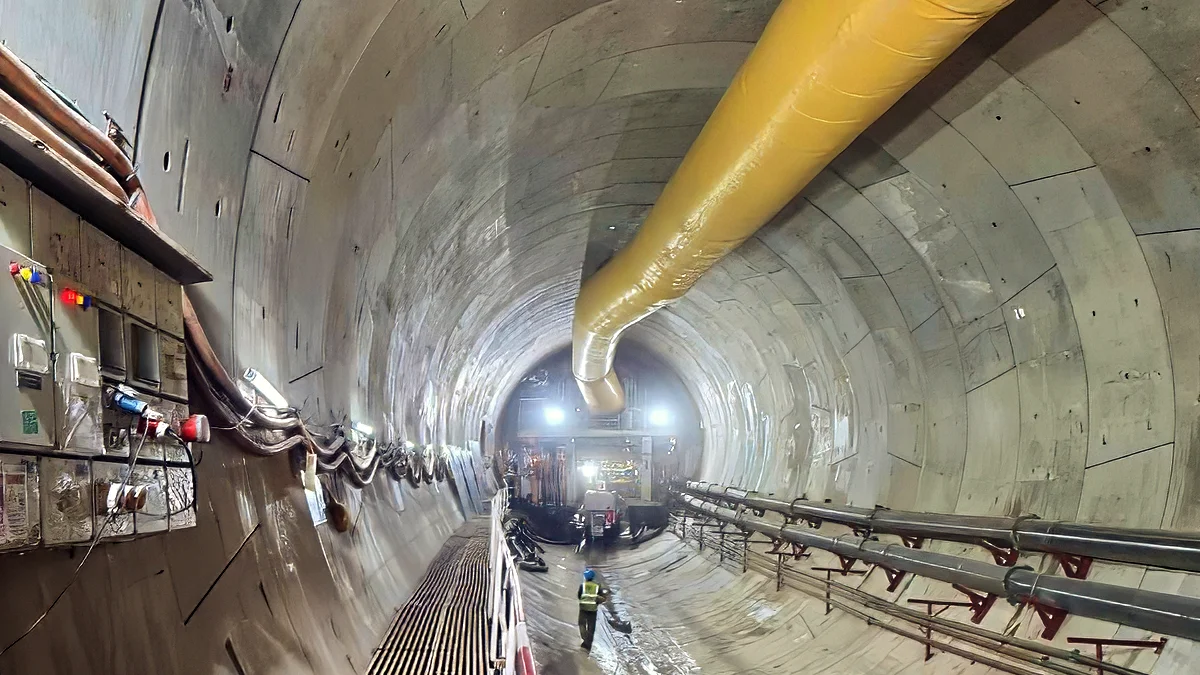
The Mumbai Metropolitan Region Development Authority (MMRDA) on Friday said it has completed around 250 metres of underground tunnelling for the Orange Gate underground road tunnel project, marking a key milestone in the city’s next-generation mobility infrastructure initiative.
The authority said the tunnelling work was carried out using an advanced Slurry Shield Tunnel Boring Machine (TBM), along with the installation of permanent segmental tunnel lining rings, a critical structural activity that converts excavation into permanent underground infrastructure.
The Orange Gate underground tunnel project is being developed as a major east-west connectivity corridor aimed at easing congestion, reducing travel time and creating additional transport capacity in Mumbai’s densely populated island city.
MMRDA said the project forms part of its broader vision to develop an integrated and multi-layered transportation ecosystem comprising metro systems, elevated corridors, coastal infrastructure and underground road networks.
The authority said the tunnel alignment passes through one of Mumbai’s most infrastructure-sensitive urban zones and requires highly calibrated excavation beneath dense built-up areas and existing utilities while ensuring uninterrupted city operations above ground.
According to MMRDA, the underground corridor is expected to reduce peak-hour travel time from nearly 40 minutes to around five minutes while helping decongest existing arterial roads and lower fuel consumption and vehicular emissions.
The project comprises twin tunnels with a total single carriageway length of around 4.8 km. Each tunnel will have two traffic lanes and one emergency lane, with a designed speed limit of 80 kmph.
The authority said the tunnel depth extends up to nearly 50 metres below ground level, with cross-passages planned every 300 metres to improve operational safety and emergency access.
MMRDA said the project deploys a high-capacity Slurry Shield TBM specifically designed for deep urban tunnelling in coastal and mixed geological conditions.
The machine has a cutter head diameter of 12.19 metres, measures around 80 metres in length and weighs approximately 2,400 tonnes, it said.
The authority added that over 575 tunnel lining rings comprising nearly 4,600 precision-engineered precast concrete segments have already been manufactured as excavation activities continue.
Chief Minister Devendra Fadnavis said the project reflects Mumbai’s transition towards future-ready mobility infrastructure.
“Mumbai is entering a new era of infrastructure development where future mobility solutions will increasingly move beyond conventional surface transport systems. Projects such as the Orange Gate underground tunnel demonstrate our commitment towards building globally benchmarked urban infrastructure that enhances mobility capacity while preserving the city’s operational efficiency above ground,” Fadnavis said.
Deputy Chief Minister and MMRDA Chairman Eknath Shinde said underground connectivity systems would become increasingly important as Mumbai continues to expand.
“The Orange Gate tunnel project represents not merely a transport corridor, but a strategic shift towards creating a multi-dimensional mobility network for MMR,” Shinde said.
Metropolitan Commissioner Sanjay Mukherjee said executing deep urban tunnelling beneath one of the country’s most densely populated urban environments required “exceptional engineering precision, planning, and safety management”.
MMRDA said the Orange Gate underground corridor is expected to play a major role in redistributing traffic flows and enabling faster connectivity across Mumbai’s residential, commercial and economic hubs.
(This article first appeared on Logistics Outlook)