A consortium of John Holland, CPB Contractors and Ghella is over halfway through the job of bringing the two mega-tools up to the surface following their 3.5km dig.
TBMs Jessie and Ruby tunnelled from The Bays to Hunter Street via Pyrmont and Darling Harbour to deliver the eastern section of the £13.4bn (A$25.3bn) Sydney Metro West scheme.
Local politicians hailed a “huge moment” when this job was completed last month, marking the end of an 11-year programme to build out the transport system across the iconic Australian city.
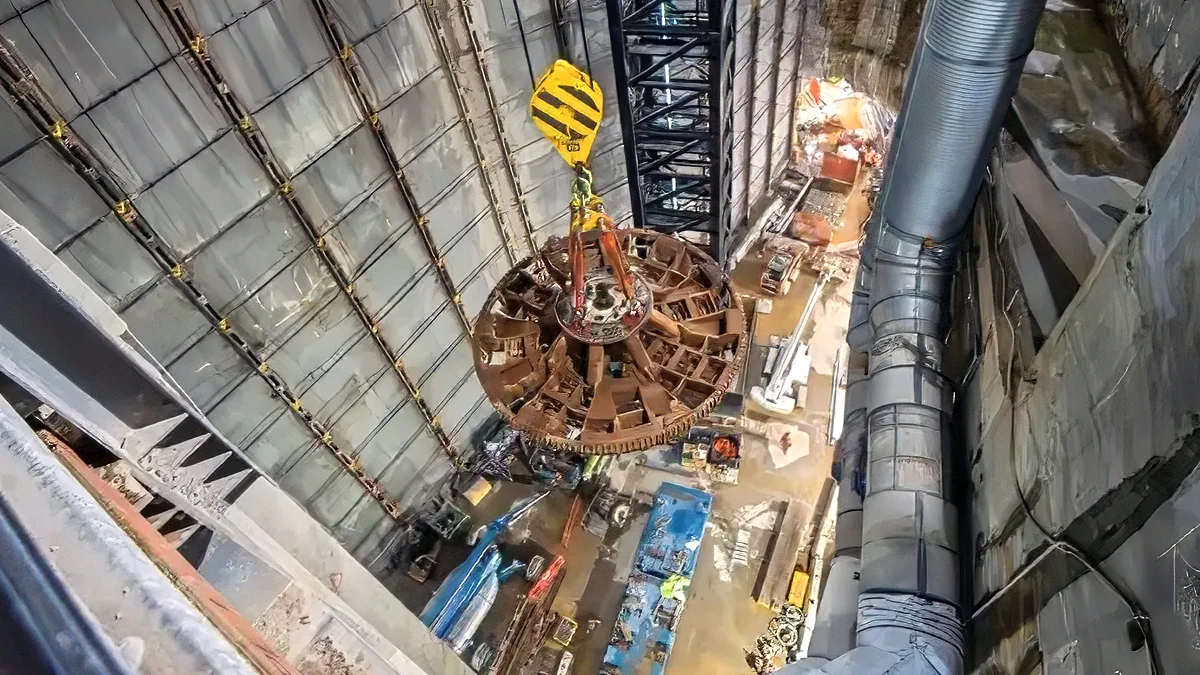
Now Jessie and Ruby are being dismantled and lifted as 16 major pieces through the Hunter Street East shaft, which will eventually become a passenger access route to the metro. Precision lifts are being carried out at night with the giant machinery transported when the city streets are quietest.
Each individual component requires a 68-wheeler truck, which heads down Elizabeth and Market streets and across the Anzac Bridge. After joining the M7 motorway, the vehicles continue to Newcastle, where a selection of the pieces will be shipped back to Herrenknecht, the German manufacturer.
Some components, including the 90t cutterheads, will be recycled as they can’t be reused.
Once the TBMs are removed from the Hunter Street station cavern, reinforcement and lining work will take place.
Construction of the 128km Sydney Metro started in 2014. Almost 15M.t of rock was excavated by 19 TBMs over 11 and a half years to create four separate underground transit lines.
Metro North West opened in May 2019 before an extension became operational five years later, known as Sydney Metro City.
Tunnelling for a standalone section including Western Sydney International Airport was completed in 2024, while Jessie’s breakthrough earlier this year marked the end of digging for the western leg.
An Acciona-Ferrovial team delivered the central section of Sydney Metro West, covering 11km of twin tunnels between The Bays and Sydney Olympic Park.
And a consortium of Gamuda Australia and Laing O’Rourke created the 9km western leg between Sydney Olympic Park and Westmead, which included a brief pause last year to review design and construction methods.
Geotechnical investigations were carried out along the length of the Sydney Metro West alignment to inform the final design of the tunnels and station boxes. More than 50 boreholes were drilled, ranging in depth from 10m to 100m.
Data captured included the depth of each layer of soil and rock, its properties and type, with work carried out to determine whether it was Ashfield Shale, Mittagong Formation or Hawkesbury Sandstone.
A local government document from 2022 showed that Hunter Street Station had a relatively thin cover of anthropogenic ground (filling) overlying a relatively thin layer of residual soils derived from the Hawkesbury Sandstone unit. The underlying bedrock is Hawkesbury Sandstone, according to the paper, which was described as medium to coarse-grained quartz-rich sandstone with occasional shale lenses.
It added that available groundwater monitoring data around the Hunter Street Station site indicated groundwater levels before tunnelling and excavation activities at between -2.0 m AHD to -6.9 m AHD and within the Hawkesbury Sandstone.
Passenger services are expected to run on Sydney Metro West from 2032, slashing a trip from Westmead to the central business district to a little over 20 minutes, and whisking people from the Olympic Park to Hunter Street in a quarter of an hour.
New South Wales premier Chris Minns said in March that the extension would “transform Sydney”.
He added at the breakthrough ceremony: “Few people would have an idea of what is going on underground, but today marks the end of the massive job that was tunnelling the 24km between Westmead and Hunter Street.”