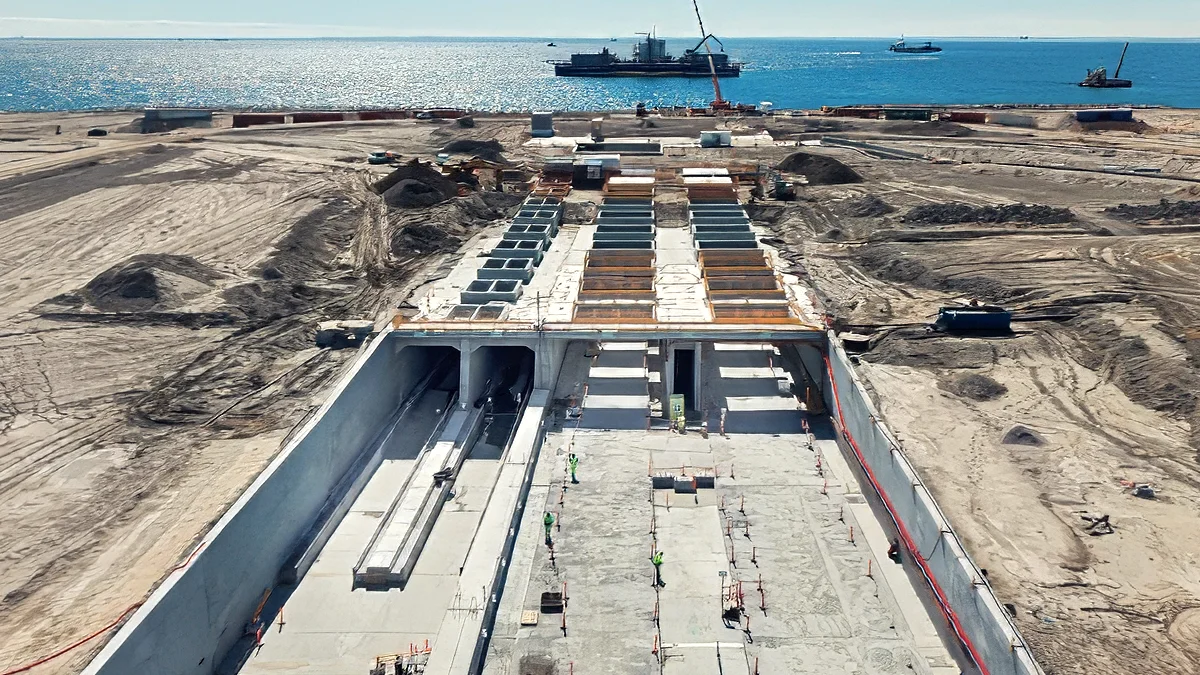

Following a complex operation that lasted several days, the first of the 89 prefabricated concrete elements forming the Fehmarnbelt tunnel has now been installed in its final underwater position. The transport operation was carried out using five tugboats and the specialised immersion vessel IVY, which moved the element from the tunnel factory in Rødbyhavn on the Danish island of Lolland to the immersion site off the coast of Denmark.
The immersion process itself took approximately 14 hours, during which the element was guided with great precision into the trench previously excavated in front of the Danish portal of the Fehmarnbelt tunnel. Once in place, it was structurally connected to the portal using hydraulic arms, allowing fine adjustments and secure positioning. The final alignment was verified using highly accurate laser measurement systems from inside the immersed element. Afterwards, the vessel IVY was detached as the operation moved on to its next phase.
In the next stage, the two immersion pontoons will be towed back to the working harbour, where they will be prepared for further operations. They will then be replaced by another specialised vessel responsible for placing large quantities of gravel along the sides of the element in order to stabilise the structure and permanently secure it within the subsea trench.
How the tunnel element is constructed
For the first time on such a scale, the construction of the Fehmarnbelt tunnel is using standardised prefabricated elements produced in series. Each element is a concrete structure, hollow inside, measuring 217 metres in length and weighing more than 73,500 tonnes. During the installation process, the element is filled with 4,500 tonnes of ballast concrete, increasing its total weight to more than 73,500 tonnes and enabling it to be lowered in a controlled manner to the seabed.
 Each Fehmarnbelt tunnel section is designed with four main traffic tubes that will eventually accommodate the motorway and railway line, alongside a separate service tube dedicated to technical equipment and maintenance access. The element is fully sealed at both ends and filled with air prior to immersion. However, the weight distribution is not naturally balanced, as the road traffic tubes are heavier than the railway tubes.
For this reason, temporary water chambers are installed in the outer railway tube to ensure that the structure remains perfectly horizontal during the controlled immersion process.
“We are both pleased and relieved. Our technology, equipment and contractors have demonstrated their capabilities and achieved something that has never been done before. It is a very important day for the project, for Denmark and Germany, and for Europe as a whole,” said Mikkel Hemmingsen, Chief Executive Officer of Sund & Bælt.
 Over the coming years, the remaining 88 tunnel elements of the Fehmarnbelt tunnel will be immersed one by one and connected inside a trench excavated on the seabed, at depths reaching up to 40 metres below the water surface.
On 2 April, Sund & Bælt announced that the immersion pontoon IVY and the specialised vessel designed to install the large tunnel elements for the Fehmarnbelt project had successfully passed all final tests and received approval from the Danish Maritime Authority. Following this stage, contractor Femern Link Contractors (FLC) began preparations for immersing the first tunnel element into the dredged trench off the coast of Lolland during the spring.
Fehmarnbelt – the world’s longest immersed tunnel
At 18 km in length, the Fehmarnbelt tunnel will become the longest immersed tunnel ever built using prefabricated immersed tunnel technology. The fixed link will connect Rødbyhavn, located on the southern coast of the Danish island of Lolland, with Puttgarden, a railway port and town situated on the German island of Fehmarn.
 The Fehmarnbelt project is regarded as a strategic component of the future European transport network, aimed at improving connectivity, strengthening trade flows and enhancing mobility between EU member states. For this reason, the Fehmarnbelt tunnel has been designated a priority project by the European Commission, which has allocated EUR 1.3 billion in funding towards its construction.
“The immersion of the first tunnel element marks a historic achievement. The tunnel will bring regions closer together and create a new dynamic between Malmö, Copenhagen, Hamburg and the rest of Europe. The European Commission will continue to support this project through to completion,” said Apostolos Tzitzikostas.
Once completed, the journey through the Fehmarnbelt tunnel will take around 10 minutes by car and approximately 7 minutes by train. At the same time, the direct rail connection will significantly reduce travel times between Copenhagen and Hamburg to around two and a half hours, compared with roughly five hours today.